
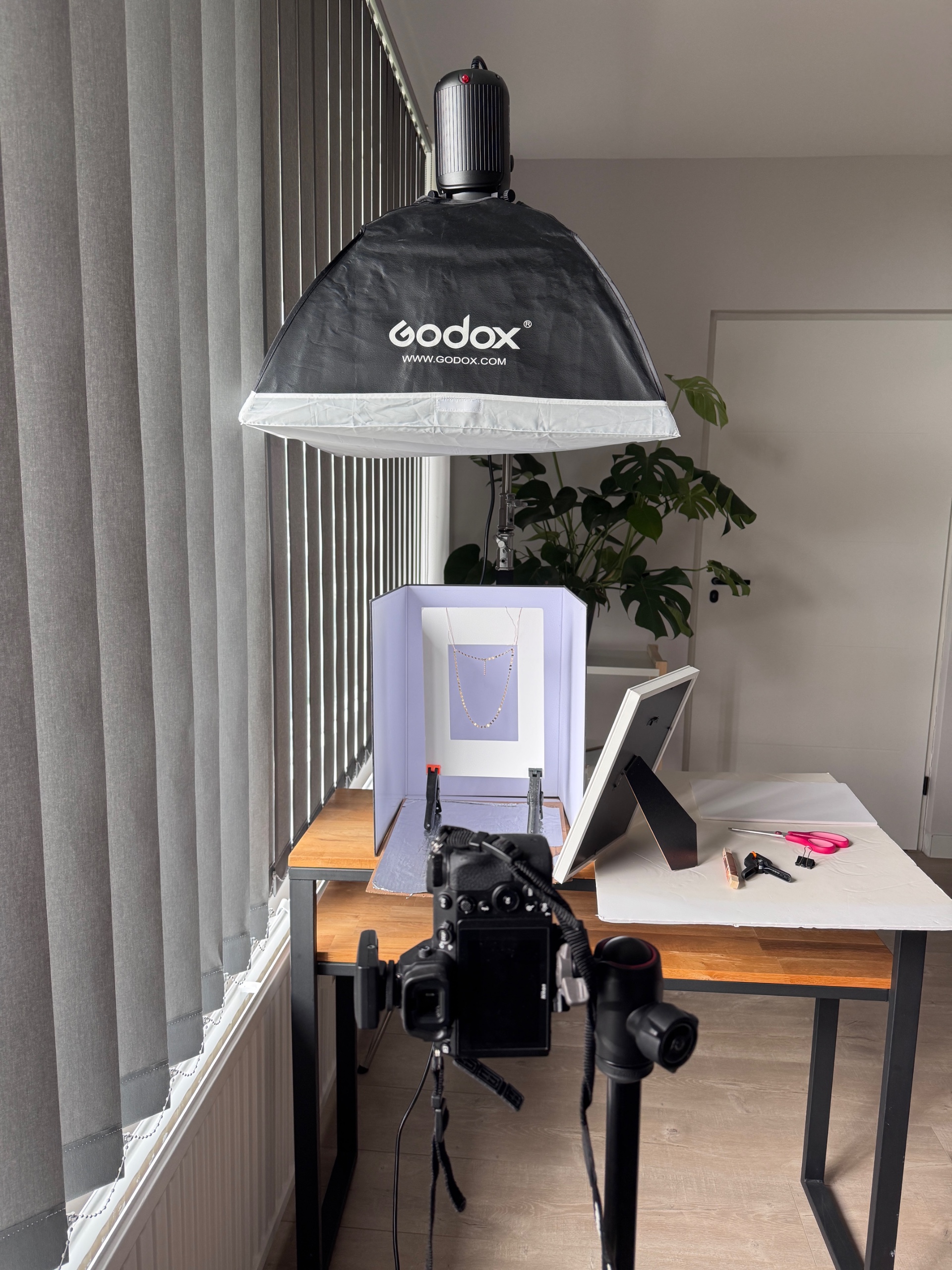
There's a moment before the camera fires when everything is still.
The light is set. The necklace is pinned just so. The softbox hums quietly overhead. Nothing moves yet, and that stillness is where the work really begins.
This is what jewellery photography looks like from the inside.
A small setup that does a lot
You don't need a large space to make careful images. What you see here is a compact light tent on a wooden table, a Godox softbox positioned overhead, a DSLR on a tripod, and a small mirror used as a reflector to the side. A monstera plant sits in the background, half out of frame. A pair of scissors rests on the table beside it.
It's a working setup. Not dressed for the camera. Just honest.
The light tent creates a controlled environment where reflections are softened and shadows fall gently. A delicate necklace is pinned against a pale lavender background inside. From this angle, you can already see how the softbox above wraps the light evenly across the surface, without harsh edges or blown highlights.
The mirror beside the tent is doing quiet work too. It catches and redirects light back into the shadow side of the piece, lifting detail without adding a second source. Small adjustments like this matter more than people expect.
Why the light tent isn't the whole answer
A light tent solves certain problems well. Reflections, consistency, clean backgrounds. But it doesn't replace judgment.
Where you place the softbox matters. How close it sits to the subject changes the quality of light, not just the quantity. A light positioned high and close will feel different from one pulled back and angled. These are decisions made by eye, adjusted slowly, checked on screen.
Jewellery is an unforgiving subject. Metal surfaces read every shift in angle. Stones reveal depth only when the light hits from the right direction. A chain can disappear entirely against a background if the tones are too similar, or become the whole image if the contrast is handled well.
For jewellery photography in Amsterdam, where many makers and independent designers work at a small scale, that kind of attention is often what separates an image that sells from one that doesn't.
What looks like a simple setup is usually the result of several small choices stacked on top of each other.
Working slowly on purpose
There's no rush in this kind of photography.
A piece gets adjusted by millimetres. The camera angle shifts. The reflector moves an inch. You look at the result, then look again. Sometimes you go back to the beginning.
This is the part of jewellery photography Amsterdam makers sometimes don't expect. The pace of it. How long a single piece can take when you're working carefully.
This is the part of product photography that doesn't often get shown. The in-between. The checking. The quiet back-and-forth between what you see and what the camera sees.
At OLA LAB, this is how we approach most of our work, not just jewellery. We prefer slow over fast, considered over reactive. The final image should feel effortless. Getting there rarely is.
What this means for your pieces
If you make jewellery, or sell it, or design it, the photography is part of the story your work tells.
A well-lit image communicates quality before a single word is read. It tells someone browsing online that the piece is worth looking at closely. It invites them to slow down.
The setup in this photograph is simple. The intention behind it is not. Every element, light, background, reflector, camera position, is there to serve the piece on that lavender board. Nothing else.
That's where we start. With the object, and with patience.
To learn more or get in touch, visit OLA LAB.
Leave a Reply